
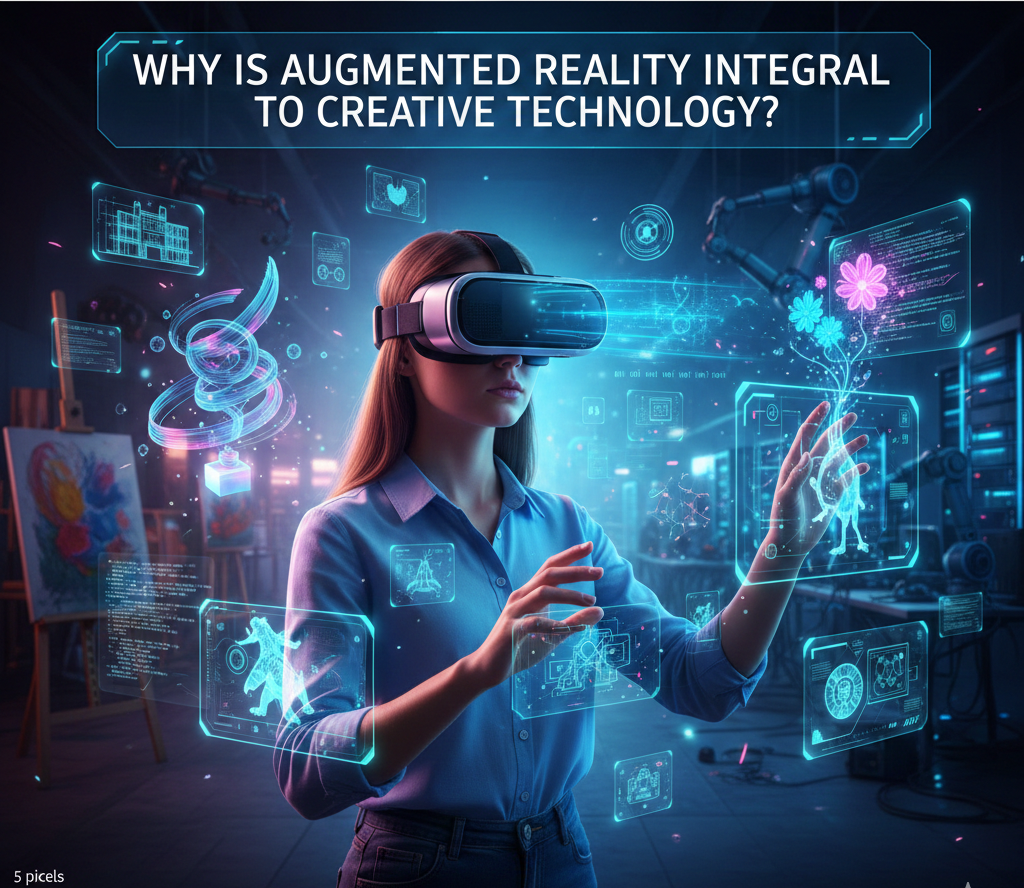
Introduction:
In this article, I’ll delve into the dynamic realm of technology and creativity, exploring the profound significance of augmented reality (AR) as a transformative force. Augmented reality, often abbreviated as AR, has emerged as a pivotal component of creative technology, reshaping the way we interact with the digital world and fostering innovative avenues for artistic expression and technological advancement.
AR seamlessly intertwines the physical and digital realms, enhancing our sensory experiences by overlaying computer-generated content onto the real world. As a result, it has revolutionized various industries, from gaming and marketing to education and design. This integration of digital elements into our everyday lives offers a unique canvas for creative minds, enabling them to craft immersive narratives, interactive art, and novel experiences that challenge the boundaries of traditional media.
Join me as we embark on a journey to uncover why augmented reality has become an integral and irreplaceable tool in the toolkit of creative technology, reshaping the way we perceive and interact with our increasingly digitalized world.
Because it enhances user experiences:
Augmented reality (AR) plays a pivotal role in enhancing user experiences by providing immersive and interactive content. Unlike traditional interfaces, AR bridges the gap between the physical and digital worlds, enabling users to engage with information and entertainment in a more natural and intuitive manner. AR apps and experiences often leverage the capabilities of smartphones, smart glasses, or headsets to superimpose digital information onto the user’s view of the physical world. This augmentation can take many forms, from informative overlays to interactive 3D models, and it has the potential to revolutionize the way we perceive and interact with our surroundings.
AR enhances user experiences by making information more accessible. For example, AR navigation apps provide real-time directions by overlaying arrows or directions onto the user’s view, making it easier to navigate unfamiliar places. Additionally, AR shopping apps allow customers to visualize products in their own homes before making a purchase, reducing the uncertainty associated with online shopping. Such enhancements in user experiences have broad applications in various industries, from tourism to e-commerce, where the seamless integration of digital information with the physical environment improves user satisfaction and decision-making.
Furthermore, AR promotes engagement through gamification. By merging the real world with digital elements, AR gaming experiences create a dynamic and interactive environment, encouraging users to explore and interact with their surroundings. This heightened engagement is not limited to entertainment; it extends to education, as AR is increasingly used to make learning more engaging and interactive. From interactive historical tours to anatomy lessons with 3D models, AR transforms educational content into immersive experiences, making learning more fun and effective.
Because it bridges physical and digital worlds:
AR acts as a bridge between the physical and digital realms, enabling users to navigate both seamlessly. It accomplishes this by superimposing digital content onto the user’s view of the real world. This fusion of the physical and digital dimensions has profound implications for creative technology.
At its core, AR transforms how we perceive and interact with reality. It goes beyond merely displaying information on screens; instead, it integrates digital elements into the user’s immediate environment. This bridging of worlds is often achieved through the use of AR devices like smartphones or smart glasses. When users look through these devices, they see both the physical world around them and virtual objects or information overlaid on that reality.
The bridge between the physical and digital worlds opens up a wealth of opportunities for creativity. Artists and designers can use AR to craft digital sculptures that appear in physical spaces, blurring the line between art and reality. Architects can use AR to visualize building designs within the context of the actual environment. This fusion of realities can be harnessed for gaming, marketing, education, and various other creative endeavors.
Because it fosters interactive storytelling:
Augmented reality (AR) introduces a new dimension to storytelling by offering interactivity and immersion that traditional media formats often lack. This is particularly relevant to creative technology as it provides storytellers, game developers, and artists with a canvas for crafting narratives that are not limited by the constraints of traditional media.
In AR, storytelling becomes an interactive experience where users are active participants. Unlike reading a book or watching a movie, AR stories invite users to engage with the plot and characters in a dynamic way. For instance, AR mobile apps can transform a simple book into an interactive adventure, where readers explore scenes, solve puzzles, and uncover hidden secrets within the story’s augmented world. This interactive element not only enhances engagement but also allows for multiple storylines and outcomes based on user choices, adding depth and reusability to narratives.
Moreover, AR fosters a deeper connection between the audience and the story’s universe. Users become immersed in the narrative as it unfolds around them in the real world. This immersion can be particularly potent in educational contexts, where AR can transport students to historical events, scientific phenomena, or literary settings. In such cases, learning becomes experiential, making complex subjects more accessible and memorable.
Additionally, AR blurs the lines between fiction and reality, making it a powerful tool for transmedia storytelling. For example, a movie or TV series can extend its storyline into the real world through AR apps, allowing fans to uncover hidden clues, interact with characters, or participate in alternate reality games. This convergence of physical and digital experiences offers new dimensions for storytelling and audience engagement.
Because it sparks innovation in design:
Augmented reality has sparked significant innovation in design across a multitude of industries, redefining how products, spaces, and user interfaces are conceptualized and developed. By seamlessly merging digital and physical elements, AR opens up new dimensions of creativity, allowing designers to explore uncharted territory and offer users unique and compelling experiences.
In product design, AR has revolutionized the prototyping and testing phases. Designers can create virtual prototypes of products and visualize how they fit into the real world. This process enhances the design feedback loop, reducing the need for physical prototypes and iterations, and ultimately speeding up the design process. It also empowers designers to experiment with novel concepts and see how they function within real-world contexts.
Moreover, AR offers an opportunity for spatial design and architecture. Architects can use AR to overlay 3D models of buildings within their surroundings, allowing them to evaluate the visual impact of a structure on an existing urban landscape. This capability not only aids in designing more harmonious and context-aware structures but also facilitates client engagement by offering immersive pre-construction experiences.
User interface (UI) and user experience (UX) design benefit immensely from AR as well. By leveraging AR in design, user interfaces can be more intuitive and user-friendly. Designers can craft interfaces that overlay information in a contextually relevant manner, reducing cognitive load for users. For instance, AR navigation apps present directions in real-world contexts, making them more intuitive and easier to follow.
Because it transforms marketing strategies:
The integration of augmented reality (AR) into creative technology has transformed marketing strategies, offering brands and businesses unique ways to engage with their audiences. AR provides a novel and interactive platform for marketing campaigns, allowing companies to create immersive experiences that captivate consumers and leave a lasting impact.
One key aspect of AR in marketing is the ability to provide immersive product experiences. Companies can develop AR apps that enable customers to virtually try on clothing, test out cosmetics, or visualize furniture in their own homes before making a purchase. These interactive experiences not only enhance the shopping process but also reduce the uncertainty associated with online shopping, ultimately boosting sales and customer satisfaction.
AR also excels in creating location-based marketing campaigns. Businesses can utilize geolocation services to deliver AR content to users in specific physical locations. For example, a restaurant could offer a virtual menu or promotions to people walking by. This type of engagement creates a strong connection between physical locations and digital marketing, increasing foot traffic and customer engagement.
Furthermore, AR marketing can be highly engaging and shareable. Brands can create AR games or experiences that users share with their social networks, thereby increasing brand exposure and virality. This social aspect of AR marketing extends its reach and effectiveness, making it a potent tool for brand promotion.
Because it engages and educates users:
Augmented reality (AR) engages and educates users in a unique and powerful way, making it an essential element of creative technology, particularly in the fields of education and training. AR transforms learning and training experiences by offering interactive, immersive, and highly engaging content.
In educational settings, AR brings abstract concepts to life. For instance, AR can be used in science education to show 3D models of complex molecules, allowing students to interact with and understand molecular structures. In history classes, students can virtually visit historical sites, experiencing events as if they were present. This dynamic, interactive approach to learning makes complex subjects more accessible and memorable.
AR is also a game-changer in vocational and technical training. It allows trainees to practice complex tasks in a safe, virtual environment. Pilots can learn to handle aircraft systems, surgeons can practice procedures, and mechanics can troubleshoot complex machinery. This hands-on training minimizes real-world risks, reduces costs, and accelerates the learning process.
Beyond education, AR engages users in various forms of content. It gamifies experiences by adding interactive elements and challenges. This gamification enhances user motivation and retention, making AR an ideal tool for edutainment and training applications.
Because it offers novel artistic avenues:
Augmented reality (AR) has opened up entirely new avenues for artistic expression and exploration. Artists have seized upon this technology to create innovative and immersive experiences that challenge conventional artistic boundaries.
AR art installations, for instance, transform physical spaces into dynamic, interactive canvases. Artists can overlay digital elements, such as 3D sculptures, animations, and audio, onto real-world environments. Viewers can then engage with and even manipulate these artworks using AR-enabled devices, creating a participatory and immersive artistic experience. These installations often blur the lines between the virtual and physical, pushing the boundaries of what is traditionally considered art.
Furthermore, AR offers a platform for artists to experiment with storytelling and narrative in new and exciting ways. The immersive and interactive nature of AR allows for the creation of multimedia stories that unfold within the user’s physical surroundings. This mode of storytelling invites users to engage with narratives in a more visceral and participatory manner, enriching the overall artistic experience.
AR also provides a canvas for the fusion of multiple art forms, from painting and sculpture to music and performance. Artists can create multisensory experiences that transcend the constraints of traditional artistic mediums. For instance, a visual artist can collaborate with a musician to create an AR installation that combines visual and auditory elements, enriching the viewer’s perception and emotional connection.
Because it challenges traditional media boundaries:
Augmented reality (AR) challenges the boundaries of traditional media by offering a new and dynamic way to engage with content. Unlike static media formats, such as print or broadcast, AR bridges the gap between the physical and digital realms, providing a platform for interactivity and immersive experiences.
Traditional media is often characterized by its one-way communication, with the audience as passive consumers. AR, on the other hand, turns this model on its head by inviting users to actively engage with content. For example, print advertisements can come to life with AR, offering additional information, interactive elements, or even games. This shift in dynamics transforms the way audiences interact with advertising, making it more engaging and memorable.
Moreover, AR has the potential to redefine how news and information are presented. AR news apps can overlay information, graphics, and videos onto the real world, allowing users to explore and interact with current events in a highly visual and immersive manner. This has the potential to make news consumption more engaging and accessible, challenging traditional news formats.
In the entertainment industry, AR transcends the limitations of traditional media by creating transmedia experiences. Movies, TV series, and books can extend their stories into the real world through AR apps, encouraging fans to explore and engage with the fictional universe. This convergence of physical and digital experiences challenges the boundaries of storytelling and audience engagement.
Conclusion:
I hope this exploration has shed light on the pivotal role of augmented reality (AR) in the realm of creative technology. AR’s transformative influence is unmistakable, with its capacity to enhance user experiences, bridge physical and digital worlds, foster interactive storytelling, spark innovation in design, transform marketing strategies, engage and educate users, open novel artistic avenues, and challenge traditional media boundaries.
In a world where the boundaries between the physical and digital domains continue to blur, AR stands as a dynamic force that reshapes how we perceive and interact with our surroundings. It empowers artists, educators, designers, and marketers to craft immersive, interactive, and innovative experiences that captivate and educate users. Moreover, AR’s ability to transcend the confines of traditional media formats ensures that it will remain integral to the ever-evolving landscape of creative technology, offering a limitless canvas for imagination and innovation.